
Use of material is possible with active link
© 2015 - 2026. Hunting, Fishing - Information Portal Support the project, donate

The wild boar
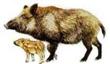
Wild boar similar to outbred pig, but much larger. Height at withers to 120 cm, weight: up to 240 kg Torso boar covered with very coarse, high (from yellow-gray to black) bristles with soft brownish podporu. By the beginning of the rutting males in the neck, shoulders and sides of the front part of the breast grows "Kalkan" (dense thickening of the skin for up to 4 cm), which serves as protection from the fangs of the opponents. Inhabited by wild boar in the southern part of Primorsky Krai (Sakhalin boar no), in Transbaikalia, Pribaikalye, Sayan and Altai, in the mountains and the river valleys of Central Asia and southern Kazakhstan. The Northern border of distribution of wild boar in Western Siberia comes to the 55th parallel. In the European part of the Russia many wild boars in the Delta of the Volga, the Caucasus and Transcaucasia, Ukraine, Belarus, Smolensk, Kaluga, Lipetsk, Voronezh, Kursk, Orel and Tula regions. Known for long calls of wild boars to the 60th parallel.
Live hogs in the swamps, reeds and tugai forests along the river valleys and the coast, in mountain forests, juniper thickets, shrub shoots, along the valleys of the foothills. Lead a sedentary lifestyle, but in the mountains every year, roam: in the spring mountains fall down in the valley. Feed mainly at night. Day spend prone to "strong". In December during the rut the males fight fiercely. In April - may, sometimes June born 10 piglets. Eat boars fallen fruits, nuts, acorns, cor n s and soup reeds and cattails, water plants, some herbs, eat snails, insects, worms, small vertebrates, destroying eggs of birds nesting on the ground. Settling near crops, especially corn, wheat, sunflower and about melon fields, causing great harm, eating and trampling crops.
The boar has exclusive burrowing ability. They can loosen the frozen earth with gravel, turn the frozen stones at her. They do it by the incisors of the lower jaw, which work like a plow. Help and fangs to break off the roots and remove the stones.
Produce hogs under licenses organize raids with dogs and guard on feeding grounds.
Boar video:

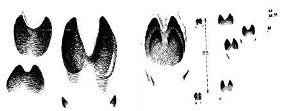
Traces of the boar:
Wild boars and hunting
Wild boars are powerful and intelligent omnivorous animals that are the ancestors of modern domestic pigs.
Main characteristics and lifestyle:
Appearance: They have a massive body covered with coarse dark brown bristles. Adult males are distinguished by sharp tusks that grow continuously and serve as weapons.
Wild boars are omnivorous. They eat roots, acorns, and fruit, but also hunt small rodents, lizards, snakes, and do not disdain carrion.
They live in groups (herds) led by an older female. Adult males usually live alone.
They are mainly nocturnal animals that rest during the day in dense thickets or swampy areas.
Pups are born with light stripes on their backs, which helps them camouflage themselves in the forest litter.
During the mating season, males develop a thick layer of cartilage (a fatty "shield") on their shoulders and chest, which protects them from the fangs of their rivals.
Wild boars have an excellent sense of smell and can detect food underground at a depth of up to 25-30 cm.
Wild boars usually avoid humans, but can be extremely aggressive if wounded, cornered, or if it is a female with piglets. The best way to escape is to climb a tree, as wild boars cannot climb trees.
Hunting wild boars is an exciting but dangerous activity that requires serious preparation and knowledge of the law.
Traditionally, wild boar hunting lasts from August to January (dates may be adjusted annually).
Main hunting methods
Driven hunt: A group of beaters drives the animal towards the line of shooters (numbers). This is the most popular and social method.
From the approach: The hunter tracks the animal on his own, guided by tracks and sounds. The best time is November-January, when the forest is bare of leaves.
From a tower (hide): Waiting for the animal near feeding places or trails. This is the safest method, allowing you to calmly choose your target.
When hunting wild boar, it is recommended to use a suitable rifled weapon or smoothbore (12 gauge) with bullets (shot is prohibited and ineffective for wild boar).
It is important to wear clothing that does not rustle and comfortable shoes. Be sure to wear bright orange items (vests, hats) for safety so that other hunters can see you from a distance.
Safety rules
Never shoot at bushes or "at sound" - only at clearly visible targets.
Remember that a wounded boar is one of the most dangerous animals; it can lie in wait and attack from behind.
Always have the meat tested for trichinosis in a laboratory before consumption.